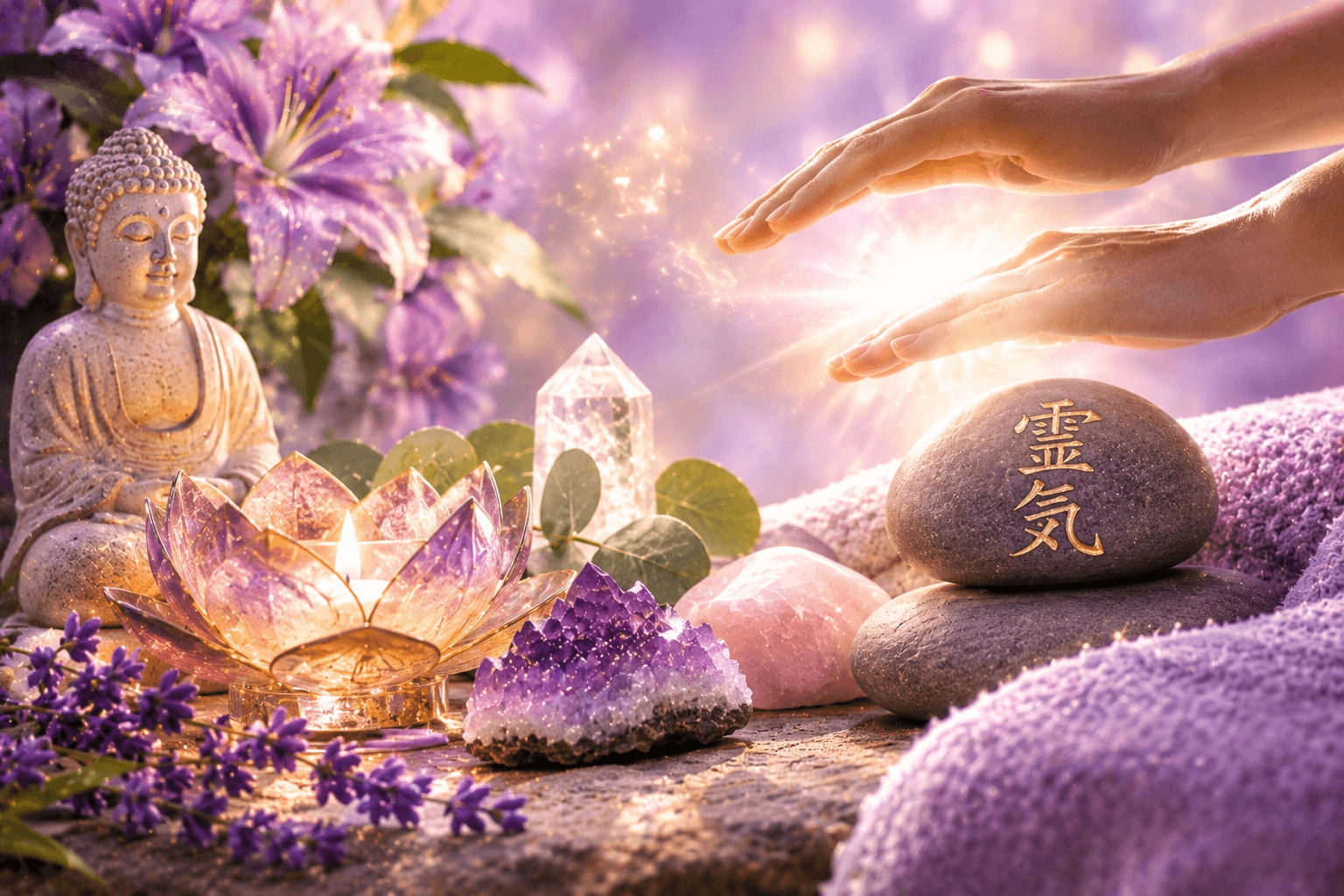
If you've ever looked into holistic wellbeing or complementary therapies, there's a good chance you've come across Reiki. It's a practice that has become increasingly familiar in wellness spaces, but if you've never experienced it, you might be wondering what it actually involves.
Is Reiki a type of massage? Does someone need to touch you? What do practitioners mean when they talk about energy, and can you practise Reiki on yourself?
These are all reasonable questions, especially when Reiki is sometimes described using terms that aren't particularly helpful to someone who's completely new to it.
Reiki is a Japanese practice traditionally based on the belief that a practitioner can work with a form of life energy through gentle hand placements. Today, people explore Reiki for different reasons, including relaxation, personal reflection and an interest in spiritual wellbeing.
In this article, we'll explore where Reiki originated, its underlying principles, what a typical session involves, how self-Reiki is practised and what you should know before deciding whether it's something you'd like to try.
1. Understanding Reiki: What Is It and Where Did It Come From?
Reiki, commonly pronounced ray-key, is a Japanese practice based on the belief in a universal life energy that exists within and around living things.
Within Reiki traditions, practitioners believe they can work with this energy through gentle hand placements to support a person's sense of balance and wellbeing.
The form of Reiki most widely practised today is associated with Mikao Usui, a Japanese spiritual teacher who developed his system in the early 1920s.
Usui's teachings combined elements of personal development, meditation, spiritual practice and hands-on techniques. His approach later spread beyond Japan through students and teachers who adapted the practice for different communities.
One important figure in this history was Hawayo Takata, who helped introduce Reiki to Hawaii and the wider Western world during the twentieth century.
Over time, different schools and styles of Reiki developed, although many continue to recognise Usui's teachings as their foundation.
What are the traditional Reiki principles?
Reiki isn't only associated with receiving a session from a practitioner. Traditional teachings also place importance on how a person approaches everyday life.
The five commonly taught Reiki principles encourage people to practise:
· Letting go of anger.
· Reducing unnecessary worry.
· Practising gratitude.
· Being honest and conscientious in daily life.
· Showing kindness and compassion towards others.
These principles are often expressed as intentions for the present day rather than strict rules that someone must follow perfectly.
They're also a reminder that Reiki, in many traditions, is considered a personal practice as much as a hands-on one.
Although Reiki has historical connections with Japanese spiritual traditions, it doesn't require someone to belong to a particular religion.
People may practise it as part of their spirituality, use it as a quiet reflective activity or simply be interested in the relaxation associated with a session.
Understanding this distinction allows people to explore the practice while keeping its traditional beliefs separate from established medical treatments.
2. How Does Reiki Work and What Happens During a Session?
Reiki sessions are generally quiet, gentle experiences that involve a practitioner placing their hands lightly on or just above a person's body.
The practitioner may explain that they're working with energy, encouraging balance or supporting relaxation. These descriptions reflect the beliefs and traditions of Reiki.
Unlike massage, Reiki doesn't normally involve manipulating muscles, applying firm pressure or moving joints.
Before the session
A practitioner may begin by explaining their approach and asking whether you have any questions or preferences.
They might also ask about your general comfort, whether you're happy with light touch and whether there are areas you'd prefer them to avoid.
You don't normally need to undress for Reiki.
Most sessions take place while you're fully clothed, either lying comfortably on a treatment table or sitting in a chair.
During the session
Once you're comfortable, the practitioner generally moves through a series of hand positions.
They may place their hands gently on your shoulders, arms or other agreed areas, or hold their hands a short distance above your body.
You can ask for a completely hands-off session if that is your preference.
The setting is often quiet, although some practitioners use soft music or subdued lighting.
You don't need to meditate, visualise anything or try to make a particular experience happen. Some people prefer to close their eyes and relax, while others remain aware of their surroundings throughout the session.
What might you feel?
People describe a range of experiences during Reiki. Some say they feel relaxed, peaceful or sleepy. Others report warmth, tingling or changes in how aware they feel of their body.
You might also feel very little, and that's perfectly normal.
What about distance Reiki?
Some practitioners offer what they call distance Reiki, where the practitioner and recipient aren't in the same location. Within Reiki traditions, this is based on the belief that energy work isn't limited by physical distance.
If you're considering a distance session, it's worth asking how it is conducted and what the practitioner expects you to do during the appointment.
3. Exploring Reiki in Everyday Life, Including Self-Reiki
Although Reiki is often associated with booking a session, it is also taught as a personal practice.
People who study Reiki may learn techniques for practising on themselves, incorporating quiet reflection, meditation and gentle hand placements into their daily routine.
This is commonly called self-Reiki.
What is self-Reiki?
Self-Reiki refers to using Reiki techniques on yourself rather than receiving a session from another person.
In formal Reiki training, a teacher generally introduces students to the system's principles, hand positions and meditation practices. Many traditions also include a ceremony or initiation referred to as an attunement or reiju, depending on the teaching style.
For students who follow these traditions, self-Reiki can become part of their regular spiritual practice.
Someone may choose to practise in the morning, before bed or whenever they want to spend a little time focusing on themselves.
What does a self-Reiki practice involve?
The exact method depends on the style of Reiki being taught, but a simple session may involve sitting or lying somewhere comfortable and placing your hands gently on different areas of your body.
For example, a trained practitioner might begin with their hands resting near their chest, then move to their abdomen or another comfortable position.
They may combine these hand placements with slow, natural breathing or quiet reflection.
There is no need to apply pressure, and any position that causes discomfort can be changed or skipped.
The intention is usually to create a calm environment and give yourself time to focus.
If you're new to Reiki and haven't received training, you can still try a simple relaxation exercise involving comfortable hand placements and natural breathing. However, this isn't necessarily the same as practising Reiki within a particular teaching tradition.
Why do people include Reiki in their routines?
For some people, self-Reiki provides a structured opportunity to slow down and take a break from everyday responsibilities. Others enjoy its connection to mindfulness, personal reflection and spiritual development.
For example, someone might finish a busy day by sitting quietly, placing their hands comfortably on their body and taking several minutes away from their phone and other distractions.
Self-Reiki can be approached as a personal or spiritual practice, but it should never replace medical treatment, mental health care or other professional support when needed.
4. Common Questions and Misconceptions About Reiki
There are common questions about Reiki, particularly when it comes to what it involves and what someone should expect.
Is Reiki the same as massage?
No. Massage generally involves physically working with the body's muscles and soft tissues.
Reiki usually involves gentle stationary hand placements or holding the hands slightly above the body, without the pressure or movements associated with massage.
Do I need to believe in Reiki for a session to be worthwhile?
You don't need to follow a particular spiritual belief to attend a session. Some people are interested in Reiki's traditional teachings, while others are simply curious about the experience.
You can enjoy a quiet, relaxing appointment without accepting every spiritual explanation associated with the practice.
Does Reiki require physical touch?
Not necessarily. Some practitioners use light touch, while others keep their hands above the body.
You can explain your preferences before the session begins, and you should always feel comfortable asking for adjustments.
Is Reiki a religion?
No. Reiki is a practice with spiritual roots, but it isn't a religion in itself.
People from different belief systems may choose to practise it, and others approach it simply as a complementary wellbeing activity.
Can anyone learn Reiki?
Reiki training is offered through different schools and teachers. Many traditional systems involve several levels of instruction, with students learning about the principles, hand positions, self-practice and, in some systems, teaching methods.
Training requirements and certificates vary between organisations. Completing a Reiki course doesn't automatically mean someone holds a regulated healthcare qualification.
Can Reiki be practised online or from a distance?
Some practitioners offer distance Reiki based on their spiritual beliefs.
5. What Reiki Can and Cannot Do: Understanding the Evidence
If you're considering Reiki, one of the most useful things you can do is understand what the practice is intended to offer and where its limitations lie.
Reiki may provide an opportunity to relax.
A quiet setting, gentle attention and time away from everyday responsibilities can contribute to a relaxing experience.
Reiki cannot replace healthcare.
A Reiki practitioner should not diagnose medical conditions, prescribe treatment or promise to cure an illness.
If you have physical symptoms, ongoing pain, mental health concerns or another medical issue, seek advice from an appropriately qualified healthcare professional.
If you're receiving treatment for an existing condition, let your healthcare team know about any complementary practices you're considering.
Your comfort and consent are important.
You should be able to ask questions, request a hands-off session or stop an appointment whenever you wish.
A responsible practitioner should explain what they offer and avoid making claims they cannot support.
Conclusion: Understanding Reiki
Reiki is a Japanese practice with a history of spiritual teaching, personal reflection and gentle hands-on techniques.
Today, people explore Reiki for different reasons. Some are interested in its traditional principles, others enjoy the quiet setting of a session, and some choose to learn self-Reiki as part of their personal routine.
The most important thing is to understand what Reiki involves and what it cannot reliably promise.
If you're curious about Reiki, take time to understand the practitioner's approach, ask questions and keep your expectations realistic.
As with any complementary practice, your comfort, informed choice and ongoing healthcare should always come first.
Important Disclaimer
Spiritual and energy healing services are complementary and are not a substitute for professional medical advice, diagnosis or treatment. Always consult a qualified health professional about any medical concern.

