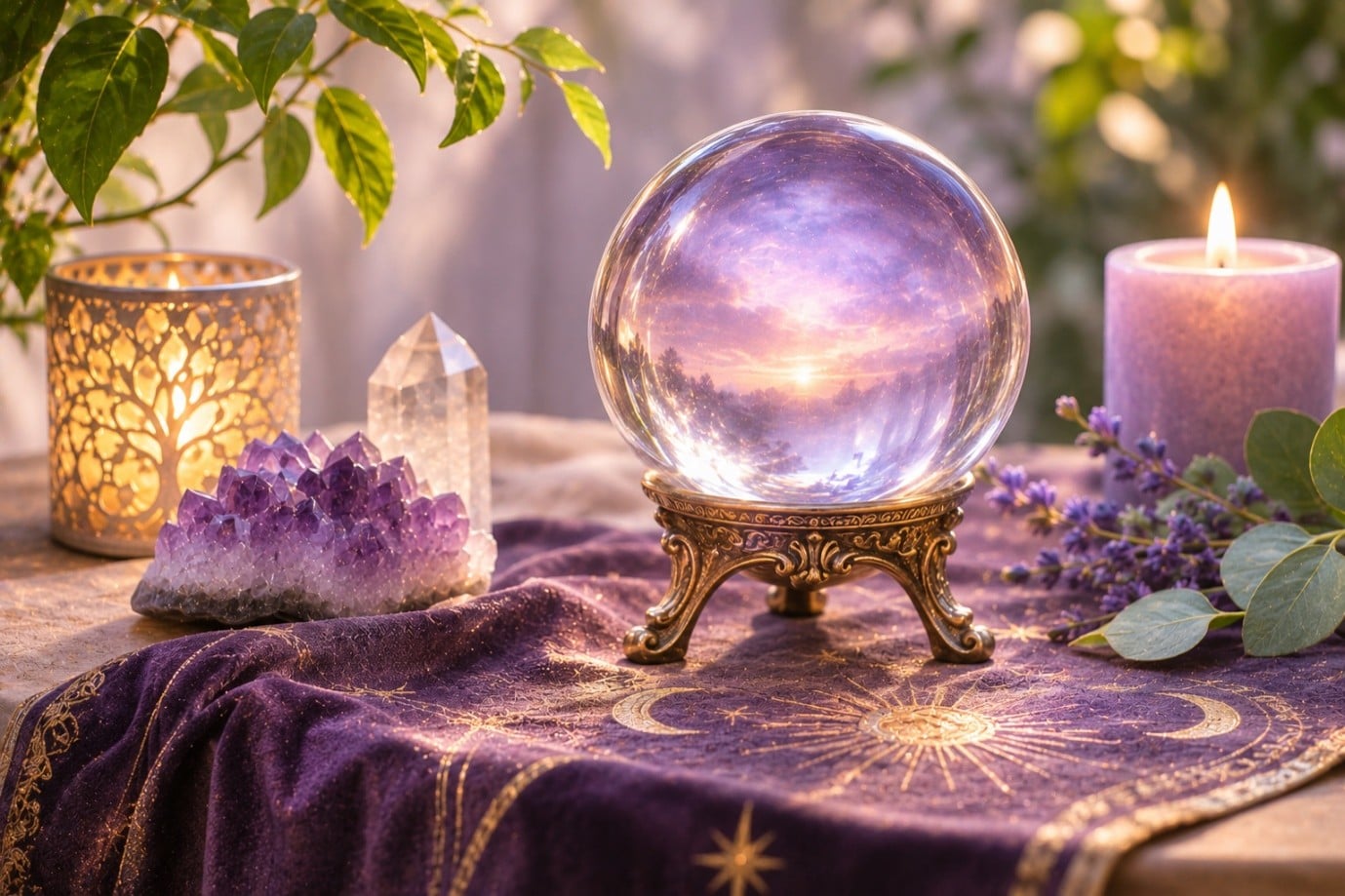
When you hear the words crystal ball reading, you might immediately picture someone looking into a glass sphere and predicting the future. It's an image we've all seen in films, television shows and stories, but there's actually quite a bit more to the practice than that.
Crystal ball readings are part of a much older tradition known as scrying, which involves looking into a reflective or translucent surface and interpreting any images, patterns or impressions that arise.
For some people, crystal ball readings are connected to their spiritual beliefs and personal intuition. Others are simply curious about how the practice works and what someone might experience during a session.
You might be wondering whether practitioners actually see pictures inside the crystal, whether the ball needs to be made from a particular material or whether a reading can genuinely tell you what's going to happen in the future.
These are all reasonable questions, particularly if you've never attended a crystal ball reading before.
In this article, we'll explore where the practice comes from, how crystal ball readings are traditionally conducted, the role of symbolism and interpretation, and what you should realistically expect if you're considering trying one.
1. Understanding Crystal Ball Readings: What Is Scrying?
A crystal ball reading is a form of divination that involves looking into a crystal or glass sphere and interpreting images, patterns, feelings or impressions that the practitioner experiences.
The practice is commonly referred to as crystal gazing or crystallomancy, and it belongs to a wider group of traditional practices known as scrying.
Scrying involves focusing on a particular surface, such as a mirror, bowl of water, polished stone or crystal, with the intention of receiving impressions or exploring symbolic meanings.
Although crystal balls are probably the most recognisable tool associated with scrying, they aren't the only objects traditionally used.
Where did crystal ball readings originate?
Practices involving reflective surfaces and their interpretation have existed across different cultures and historical periods.
Water, polished stones and mirrors have all been used in various divination traditions, often in connection with religious beliefs, spiritual practices or attempts to understand events beyond ordinary observation.
Crystal gazing also became associated with European occult and divination traditions. It attracted particular public interest during the nineteenth and early twentieth centuries, when spiritualism, fortune-telling and other forms of divination became popular.
Over time, the crystal ball developed into a familiar symbol of fortune-telling, particularly through entertainment and popular culture.
However, the modern image of a fortune-teller making definite predictions doesn't necessarily represent how every practitioner approaches crystal ball readings today.
Does the crystal ball have special properties?
Some practitioners believe that particular crystals have spiritual or energetic qualities that support intuitive work.
Others view the ball simply as a tool for concentration, reflection and interpreting visual impressions.
Crystal balls can be made from different materials, including clear quartz, other polished minerals and glass.
For someone new to the practice, it's useful to understand that a crystal ball reading is based on spiritual traditions and personal interpretation.
2. How Does a Crystal Ball Reading Traditionally Work?
Although every practitioner has their own approach, most crystal ball readings involve a quiet setting, focused attention and the interpretation of visual or intuitive impressions.
The crystal ball is generally placed on a stand or stable surface where the practitioner can look into it comfortably.
Some practitioners prefer soft lighting or a darker background because this can make reflections, shapes and changes in the appearance of the crystal easier to notice.
Others may conduct readings in an ordinary room without any particular arrangements.
What does the practitioner actually do?
During a traditional crystal gazing session, the practitioner looks into the crystal while maintaining a relaxed, focused state.
Rather than searching for a specific object, they may allow their attention to settle and observe whatever impressions arise.
Some practitioners describe noticing colours, shapes, shadows or patterns. Others report experiencing mental images, memories, feelings or associations while looking at the crystal.
Our perception can be influenced by lighting, reflections, imagination, expectations and the way our brains interpret visual information.
What role does symbolism play?
Symbolism is an important part of many crystal ball readings.
For example, a practitioner might associate an image resembling a doorway with change or a new opportunity.
An impression of a winding road might be interpreted as representing a journey, a decision or a period of uncertainty.
These are examples of symbolic interpretation rather than fixed meanings or reliable predictions.
Different practitioners may interpret the same image in different ways, depending on their traditions, experiences and personal understanding.
Is scrying the same as psychic reading?
Crystal ball reading is often grouped under psychic, mediumship or intuitive readings, although not every practitioner describes their work in the same way.
A practitioner may use the crystal as a central part of the session, while another may combine crystal gazing with tarot cards, meditation or general intuitive discussion.
This is why it's worth reading the service description before booking.
The important thing to remember is that the information shared during a reading involves interpretation. No image, symbol or impression can reliably guarantee a particular future event or outcome.
3. What Might Someone Experience During a Crystal Ball Reading?
If you've never attended a crystal ball reading before, you may be curious about what actually happens during the appointment.
In many ways, the experience is similar to other spiritual or intuitive readings, although the practitioner uses a crystal ball as part of their approach.
Before the reading begins
A session may start with a brief introduction, giving the practitioner an opportunity to explain how they use the crystal and what the reading involves.
Some practitioners ask whether you have a particular question or area of interest.
For example, you might be curious about personal development, relationships, a decision you're considering or simply how crystal gazing works.
Others prefer to begin without much background information and share their impressions as the session progresses.
You don't need to prepare anything complicated, and you shouldn't feel obligated to provide personal details you're uncomfortable sharing.
During the reading
The practitioner may spend some time looking into the crystal before describing the images, symbols or impressions they experience.
For example, they might mention seeing a shape that reminds them of water or a landscape.
They may then interpret that image symbolically, perhaps discussing themes such as change, reflection or uncertainty.
Another practitioner might describe a colour, a feeling or a particular image that comes to mind. The details and interpretations can vary considerably.
It's also worth understanding that the person receiving the reading doesn't necessarily see the same images as the practitioner.
In some cases, the practitioner may be describing mental impressions rather than something physically visible inside the crystal.
What if the information doesn't make sense?
That's perfectly fine. You don't need to agree with every interpretation or find a personal connection with something that doesn't feel relevant.
A practitioner may ask whether an image or theme means anything to you, but you should never feel pressured to make the information fit your circumstances.
It's reasonable to say that you don't recognise something or that an interpretation doesn't resonate with you.
How might someone feel afterwards?
Some people enjoy crystal ball readings because they find the experience interesting or reflective. Others may appreciate discussing their circumstances from a different perspective.
You might leave with something to think about, or you may simply decide that the practice isn't for you. There is no particular emotional response that you're expected to have.
The value someone takes from the experience will depend on their own beliefs, expectations and interpretation.
4. Common Questions and Misconceptions About Crystal Ball Readings
There are quite a few misconceptions surrounding crystal ball readings, especially because of how they're often portrayed in films and popular culture.
Here are some of the most common questions.
Can a crystal ball really show the future?
Many have wonderful reviews to say they can. However, no practitioner can reliably guarantee what will happen in the future.
Do practitioners actually see images inside the crystal?
Some practitioners describe seeing visual patterns or shapes, while others experience mental images or impressions during focused attention.
These experiences may have different explanations, including reflection, imagination and visual perception.
There is no established evidence that the crystal contains supernatural images.
Does the crystal ball need to be made from real crystal?
Not necessarily. Traditional and modern practitioners use different materials, including quartz, polished minerals and glass.
Some prefer a particular material for personal or spiritual reasons.
Is a crystal ball reading the same as a tarot reading?
No. Tarot readings involve interpreting cards and their associated imagery or symbolism.
Crystal ball readings involve gazing into a reflective or translucent sphere and interpreting any impressions that arise.
Both may be used within divination traditions, but their methods are different.
Can a crystal ball reading connect me with someone who has passed away?
Traditional crystal gazing and mediumship are different practices. Some practitioners may combine crystal gazing with mediumship, but using a crystal ball doesn't automatically mean the session involves attempted communication with your loved ones.
Do I need to believe in crystal ball readings?
No. Some people explore these practices because of their spiritual beliefs, while others are simply interested in the history, symbolism or experience.
You can be curious without feeling pressured to accept every interpretation.
5. Things to Consider Before Booking a Crystal Ball Reading
If you're interested in trying a crystal ball reading, there are a few practical things worth keeping in mind.
Understand what type of reading you're booking.
Not every practitioner uses a crystal ball in the same way. Some focus on traditional scrying, while others combine crystal gazing with psychic, mediumship or intuitive guidance.
Read the session description carefully so you have a clear understanding of what's included.
Take time to look into the practitioner.
Check their profile, approach, experience and any available customer feedback
Keep your expectations realistic.
Crystal ball readings are based on spiritual interpretations and symbolic practices.
They shouldn't be treated as a reliable way to predict future events, uncover hidden facts or make important decisions.
You may find certain themes interesting or personally meaningful, but there is no guarantee that every interpretation will be relevant to you.
Remember that you're entitled to ask questions.
If the practitioner describes a symbol or impression you don't understand, it's perfectly reasonable to ask what they mean.
You can also disagree with an interpretation or choose not to share personal information. A respectful practitioner should allow you to make your own decisions about what the experience means to you.
Don't rely on readings for professional advice.
Crystal ball readings are not a substitute for medical, psychological, legal or financial advice.
If you're facing an important decision or dealing with a serious concern, seek guidance from an appropriately qualified professional.
Consider your emotional wellbeing.
If you're going through a difficult time, you may be particularly interested in receiving reassurance or answers.
It's important to remember that a reading cannot guarantee either.
A supportive experience should leave you feeling respected and free to make your own choices, rather than dependent on further readings.
Ultimately, crystal ball readings are best approached with curiosity, realistic expectations and an understanding of their limitations.
Conclusion: Understanding Crystal Ball Readings
Crystal ball reading is a traditional form of scrying that uses a crystal or glass sphere as a focus for visual impressions and symbolic interpretation.
Although the practice is often associated with predicting the future, there's much more to its history and traditional methods than the familiar image of a fortune-teller looking into a crystal ball.
Today, people explore crystal gazing for different reasons, including spiritual curiosity, personal reflection and an interest in divination traditions.
The most important thing to understand is that interpretations are subjective, experiences vary and no future event or outcome can be guaranteed.
If you're considering a crystal ball reading, take time to understand the practitioner's approach, ask questions and remember that you're always free to form your own opinion about the experience.
Important Disclaimer
Readings and spiritual guidance on Majik Gift are provided by independent practitioners for entertainment and personal insight. They cannot predict the future with certainty and should not be relied on for medical, legal, financial or mental health decisions.

