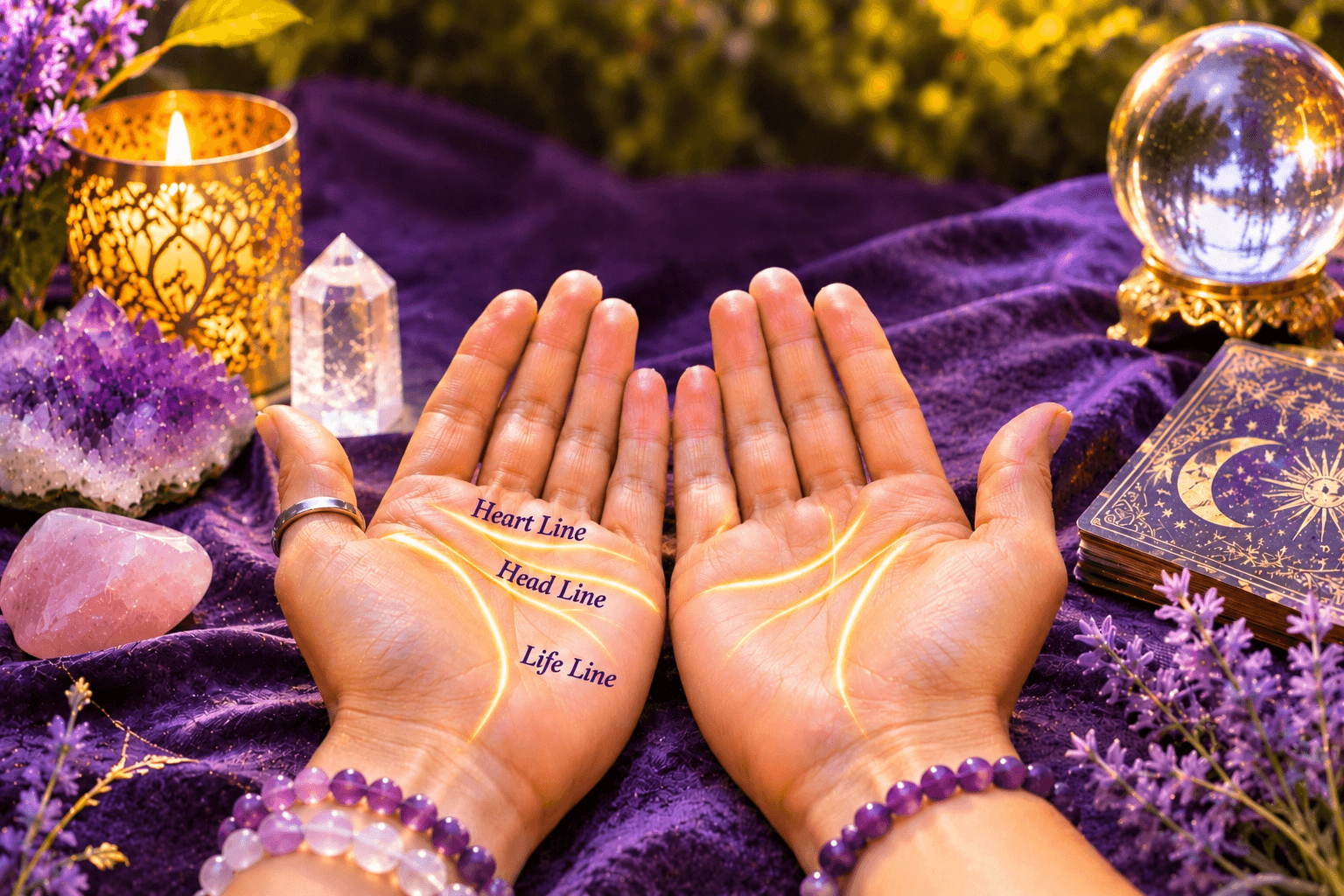
Your Hands Are Unique — And Within Their Lines Lies a Fascinating Tradition of Spiritual Discovery
Have you ever looked at the lines on your palms and wondered what they might mean?
Perhaps you've noticed that the patterns on your hands are completely different from those of your family or friends.
For thousands of years, people across different cultures have been fascinated by the belief that our hands can offer insights into our personalities, relationships, emotions and life experiences.
This ancient practice is known as palm reading, palmistry or chiromancy.
For many people, palm reading is more than simply examining the lines on a hand. It is an opportunity to explore personal characteristics, reflect on life's experiences and discover the symbolism associated with this traditional spiritual art.
Whether you're curious about palmistry or considering your first professional palm reading, understanding its history and traditional meanings can make the experience even more interesting.
What Is Palm Reading?
Palm reading is the traditional practice of interpreting the lines, shapes and features of the hands to explore aspects of personality, relationships, personal strengths and life's journey.
Palmistry has historical connections with traditions in India, China and other parts of the world, where different systems of hand interpretation developed over time.
In many spiritual traditions, the hands are believed to reflect aspects of our inner nature and personal experiences.
Palm readers may examine several features, including:
- The major lines across the palm.
- The overall shape of the hand.
- The length and proportions of the fingers.
- The raised areas of the palm, known as mounts.
- Smaller markings and patterns.
- Differences between the left and right hands.
Each feature carries traditional meanings that may vary depending on the palmistry system being used.
Palm reading invites us to explore the symbolism of our hands while reflecting on the qualities and experiences that make us unique.
1. The Life Line — Your Journey and Vitality
One of the most recognised features in palmistry is the life line.
The life line generally curves around the base of the thumb, beginning near the space between the thumb and index finger.
Within traditional palmistry, it is associated with vitality, life experiences, personal energy and significant periods of change.
A common misunderstanding is that the length of the life line determines how long someone will live.
In palmistry traditions, however, the life line is more commonly interpreted as a symbol of life's journey rather than a literal measurement of lifespan.
Some readers consider its depth, curvature and markings when discussing themes such as resilience, enthusiasm and personal development.
The life line reminds us that every person's journey is different, filled with opportunities to learn, grow and embrace change.
2. The Heart Line — Love and Emotional Connections
The heart line is usually found across the upper part of the palm, beneath the fingers.
In traditional palmistry, it is associated with emotions, affection, relationships and the ways people express love.
Palm readers may consider the line's shape, length and position when exploring themes such as:
- Emotional expression.
- Personal relationships.
- Compassion and affection.
- Communication in relationships.
- Emotional awareness.
- The importance of meaningful connections.
For example, a gently curved heart line is sometimes interpreted as representing an expressive or affectionate nature.
A straighter heart line may traditionally be associated with a more reserved or practical approach to emotions.
These interpretations are symbolic and can differ between palmistry traditions.
Love is one of life's most meaningful experiences, and the heart line offers a beautiful opportunity to reflect on how we give, receive and understand affection.
3. The Head Line — Thoughts, Creativity and Decision-Making
The head line generally runs across the middle of the palm.
Within palmistry, it is traditionally associated with thinking patterns, imagination, communication and approaches to decision-making.
Some palm readers interpret a long, clear head line as symbolising concentration or thoughtful consideration.
A curved or sloping head line may be associated with imagination, intuition or creativity.
The head line can inspire reflection on questions such as:
- Do I enjoy creative thinking?
- How do I approach important decisions?
- Am I open to exploring different perspectives?
- What helps me feel confident in my choices?
- How can I continue learning and developing my abilities?
Palmistry encourages curiosity about these qualities while recognising that our thoughts, abilities and interests can develop throughout life.
4. The Fate Line — Direction and Personal Purpose
The fate line, sometimes called the destiny line, generally runs vertically through the centre of the palm.
Not everyone has a clearly defined fate line, and its appearance varies considerably.
Within traditional palmistry, it is often associated with career direction, personal purpose, responsibilities and significant life transitions.
Some palm readers interpret changes or breaks in this line as symbols of different stages in a person's journey.
However, the presence or absence of a fate line does not determine someone's success, happiness or future.
Your future is shaped by many influences, including your experiences, circumstances, opportunities and the choices you make along the way.
Palmistry can provide an interesting opportunity to reflect on where you've been and where you would like to go.
5. Understanding the Different Hand Shapes
In some palmistry traditions, hands are grouped into four main categories associated with the classical elements: earth, air, fire and water.
These categories are symbolic and are used to explore different personality themes.
Earth Hands — Practicality and Stability
Earth hands are traditionally described as having square palms and relatively short fingers.
They are often associated with qualities such as reliability, patience, practicality and a grounded approach to life.
Air Hands — Communication and Curiosity
Air hands are commonly described as having square or rectangular palms with longer fingers.
Within palmistry, they are associated with communication, curiosity, intellectual interests and creative thinking.
Fire Hands — Passion and Enthusiasm
Fire hands are traditionally described as having longer palms and shorter fingers.
They are often linked with energy, enthusiasm, confidence and a desire for new experiences.
Water Hands — Sensitivity and Intuition
Water hands are commonly described as having longer palms and long, slender fingers.
In traditional interpretations, they are associated with imagination, sensitivity, emotional awareness and intuition.
These descriptions offer a fascinating introduction to the symbolism used in palmistry.
Remember that every hand is unique, and people can identify with qualities from several different categories.
6. The Mounts of the Palm and Their Meanings
Another interesting area of palmistry involves the raised sections of the palm, traditionally known as mounts.
Many of these mounts are named after figures from Roman mythology and are associated with different personal qualities.
Mount of Venus
Located near the base of the thumb, the Mount of Venus is traditionally associated with affection, warmth, enjoyment and personal relationships.
Mount of Jupiter
Found beneath the index finger, the Mount of Jupiter is associated with ambition, leadership and confidence.
Mount of Saturn
Located beneath the middle finger, this mount is traditionally linked with responsibility, reflection and discipline.
Mount of Apollo
Found beneath the ring finger, the Mount of Apollo is associated with creativity, artistic expression and appreciation of beauty.
Mount of Mercury
Located beneath the little finger, the Mount of Mercury is traditionally connected with communication, adaptability and expression.
These interpretations form part of palmistry's rich symbolic traditions and can vary between practitioners.
7. Can the Lines on Your Palms Change?
Have you ever compared your hands with an old photograph and noticed differences?
The appearance of our hands can change over time due to ageing, skin condition, movement and everyday activities.
Within some palmistry traditions, changes in the lines are also interpreted symbolically as reflecting personal growth or different stages of life.
For people interested in palmistry, observing their hands over time can become a meaningful practice of reflection and self-discovery.
It may encourage us to consider how our experiences, priorities and perspectives evolve as we grow older.
Life is constantly changing, and every new experience gives us an opportunity to discover something about ourselves.
8. What Happens During a Palm Reading?
If you've never experienced a palm reading before, you may be wondering what to expect.
A professional palm reading usually begins with a conversation about the service and what the client hopes to explore.
The practitioner may then examine one or both hands, paying attention to the major lines, hand shapes, fingers and mounts.
During the reading, they may discuss traditional interpretations associated with:
- Personality characteristics.
- Emotional expression and relationships.
- Personal strengths and interests.
- Creativity and communication.
- Life experiences and transitions.
- Personal aspirations and goals.
Some palm readers also incorporate intuition or other spiritual practices into their sessions.
Every practitioner has their own approach, so it's helpful to read the service description before booking.
A palm reading should be a respectful experience where you feel comfortable asking questions and exploring the information shared.
9. Palm Reading and Personal Choice
One of the most important things to remember about palmistry is that your life remains your own.
Traditional interpretations may offer interesting perspectives, but they do not need to define your identity or determine your decisions.
You are continually learning, growing and responding to new experiences.
Your relationships, career, interests and personal direction can change throughout your lifetime.
A palm reading can be enjoyed as a spiritual experience, a cultural tradition or an opportunity for personal reflection.
Your hands may tell a symbolic story, but you are the one living and creating your journey.
10. How to Choose a Palm Reader
Finding a practitioner you feel comfortable with can help make your first palm reading a more enjoyable experience.
Before booking, consider:
- Reading the practitioner's profile and service description.
- Exploring genuine customer reviews.
- Checking their experience and approach to palmistry.
- Understanding the session duration and price.
- Asking whether the reading is available online or in person.
- Choosing someone who respects your beliefs and personal boundaries.
A responsible practitioner should explain their service clearly and allow you to make your own choices.
Palm readings are best approached with curiosity and an open mind, without feeling pressured to make important life decisions based on a single interpretation.
The Beauty of Palmistry — Every Hand Tells a Different Story
Take a moment to look at your hands.
Think about everything they have experienced throughout your life.
The hands that held someone you loved.
The hands that worked towards your dreams.
The hands that offered comfort during difficult moments.
The hands that created, helped, supported and embraced the people around you.
Every line, curve and marking is part of what makes your hands unique.
Palmistry invites us to explore the symbolism of those features while reflecting on the extraordinary journey of being human.
Perhaps the greatest inspiration we can take from palm reading is the reminder that every person has their own experiences, strengths and possibilities.
Your journey is uniquely yours. Embrace your individuality, appreciate your experiences and remain open to the wonderful opportunities that life may bring.
Explore Palm Reading and Spiritual Services on Majik Gift
At Majik Gift, we believe in creating a welcoming global community where people can explore spirituality, wellness, personal growth and different traditions of self-discovery.
Our Learn section shares educational articles, inspiring stories and information about spiritual practices from around the world.
Whether you're interested in palm reading, mediumship, tarot, astrology, numerology or spiritual development, Majik Gift offers opportunities to learn about different practices and explore what resonates with you.
Majik Gift – Healing the World Together.
An Invitation to Explore: Palmistry is a traditional spiritual and cultural practice involving symbolic interpretations of the hands. Individual experiences and interpretations may vary. This article is provided for general education, inspiration and personal interest. Palm readings are not substitutes for professional medical, legal or financial advice.

